

- By Della tj
- December 2, 2025
- import from china, logistics process, Shipping
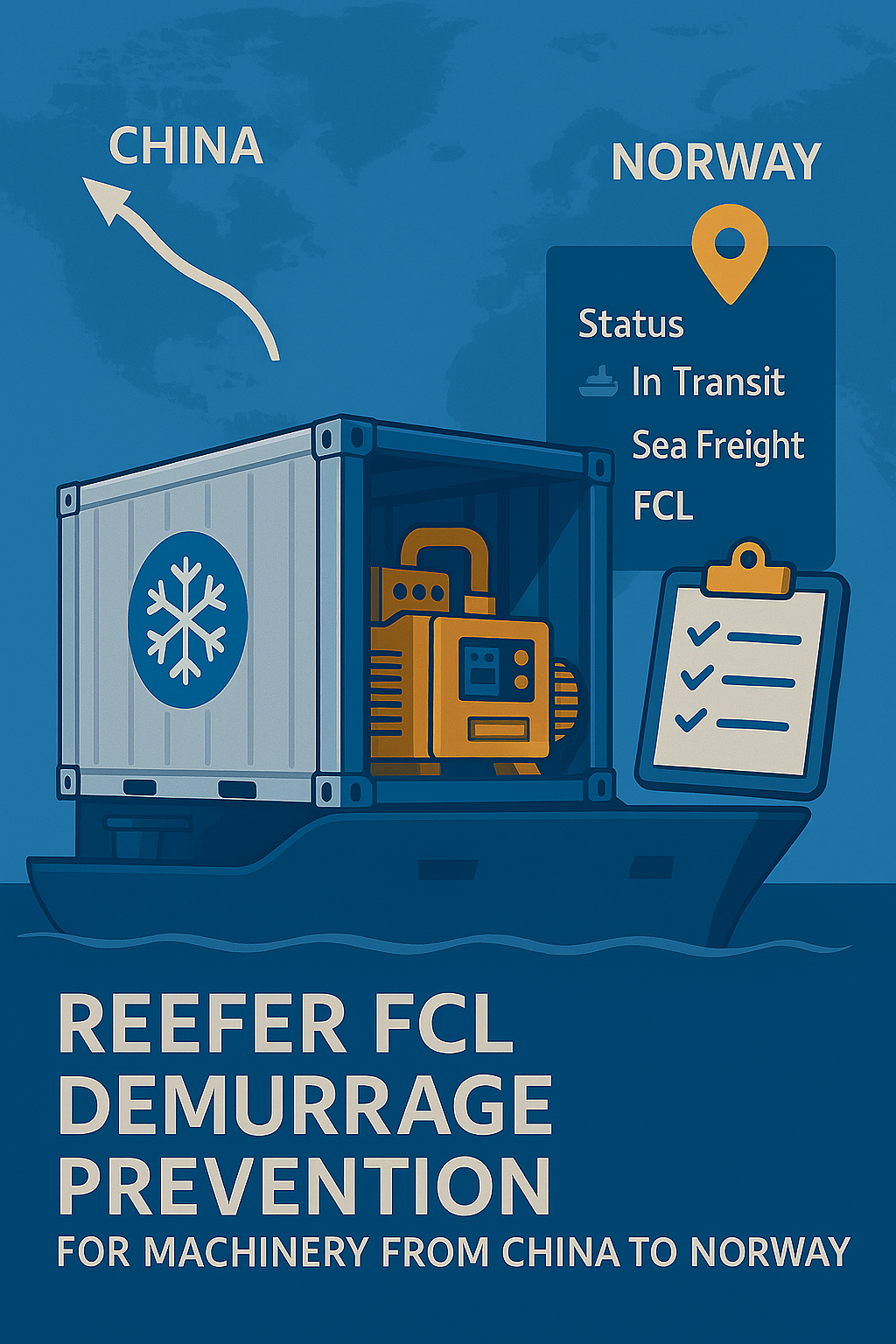
Managing Reefer FCL demurrage prevention for machinery from China to Norway is vital for exporters handling temperature-sensitive or high-value industrial equipment. Since reefer containers are costly to rent and operate, even small delays at customs or ports can lead to high demurrage fees. This guide explores cost structures, shipping routes, customs coordination, and proven prevention strategies for exporters and importers shipping refrigerated or humidity-controlled machinery.

A Reefer FCL (Full Container Load) container maintains a controlled temperature and humidity range—essential for machinery with sensitive electronic or metal components prone to rust or condensation.
| Container Type | Temperature Range | Best For | Capacity (40HQ) |
|---|---|---|---|
| Reefer FCL | –25°C to +25°C | Precision machinery, electronics, equipment parts | 67.7 m³ |
| Dry FCL | Ambient only | Regular cargo | 76.4 m³ |
| Open Top | Oversized items | Heavy machinery | 70 m³ |
Using reefer containers for high-end machinery from China to Norway helps maintain product quality throughout long-distance maritime transit.
Demurrage occurs when the container stays at the port longer than the allowed free days, typically 3–5 days. For reefer units, the daily charge can reach USD 150–300 due to power supply costs.
| Cause | Description | Prevention |
|---|---|---|
| Customs Delay | Missing or incorrect import documents | Pre-clearance filing |
| Port Congestion | Vessel delay or limited reefer slots | Real-time tracking |
| Payment Issues | Delayed duty or VAT payment | Pre-payment arrangements |
| Uncoordinated Pickup | Truck unavailability | Schedule 48 h before ETA |
Planning, communication, and proactive tracking help minimize these costly time losses.
| Route | Port of Loading | Port of Discharge | Transit Time | Mode |
|---|---|---|---|---|
| Shenzhen → Oslo | Yantian | Oslo | 35–38 days | Sea |
| Ningbo → Bergen | Ningbo | Bergen | 36–40 days | Sea |
| Shanghai → Oslo | Waigaoqiao | Oslo | 37–41 days | Sea |
| Tianjin → Kristiansand | Xingang | Kristiansand | 40–43 days | Sea + Rail |
Some forwarders also use Hamburg or Rotterdam as transshipment hubs, trucking or short-sea shipping to Norway.
The following best practices minimize demurrage risks and ensure cargo freshness and integrity.
| Stage | Action | Benefit |
|---|---|---|
| Pre-Shipment | File all customs and import declarations early | Avoid clearance delay |
| Vessel Booking | Choose carriers with reefer plug guarantees | Ensure power availability |
| Real-Time Tracking | Monitor container through GPS + EDI | Detect port congestion early |
| Delivery Coordination | Schedule truck before vessel arrival | Faster pickup |
| Documentation | Ensure HS Code, invoice, and CO complete | Smoother inspection |
Additionally, digital pre-advice systems automatically alert importers 48 hours before free time expiry.
Case 1 – Shenzhen to Oslo
Cargo: CNC precision machines (40HQ Reefer)
Transit: 36 days
Cost: USD 7,850
Result: Pre-cleared customs and coordinated truck dispatch saved USD 450 demurrage; humidity maintained at 45%.
Case 2 – Ningbo to Bergen
Cargo: Industrial cutting machines (20GP Reefer)
Transit: 38 days
Cost: USD 6,200
Result: EDI tracking warned of berth congestion; shipper rerouted via Rotterdam to meet delivery schedule.
| Cost Item | Description | Average (USD) |
|---|---|---|
| Sea Freight | Ocean transit cost | 6,500–8,200 |
| Port Handling | Terminal and reefer plug fees | 400–600 |
| Insurance | Machinery + temperature coverage | 200–350 |
| Customs Duty + VAT | Based on product type | 5–25% of CIF |
| Trucking to Inland Norway | Oslo → Bergen or Stavanger | 500–900 |
Proper budgeting and early coordination reduce overall logistics expenses.
| Document | Purpose | Issued By |
|---|---|---|
| Bill of Lading | Confirms shipment ownership | Carrier |
| Packing List | Lists machinery details | Exporter |
| Commercial Invoice | Declares value for duty | Supplier |
| Certificate of Origin | Verifies manufacture country | Chamber of Commerce |
| Import License | Needed for industrial equipment | Norwegian Customs |
| Customs Declaration | Filed before arrival | Importer or Broker |
Pre-validating HS codes and ensuring correct valuation prevent customs re-inspection delays.
TopChinaFreight specializes in reefer container logistics for sensitive industrial equipment:
- Advanced Reefer FCL demurrage prevention technology with GPS + EDI alerts.
- Door-to-door solutions from factory to Norwegian warehouse.
- Customs brokerage support to ensure zero inspection delay.
- Climate-controlled monitoring throughout transit.
- 24/7 tracking and demurrage risk notifications.
In conclusion, managing Reefer FCL demurrage prevention for machinery from China to Norway demands proactive coordination, accurate documentation, and digital tracking. By preparing customs entries in advance, booking with reliable carriers, and monitoring in real time, businesses can prevent unnecessary storage fees and maintain machinery integrity. TopChinaFreight delivers complete reefer logistics—combining technology, compliance, and efficiency for successful delivery across Norway.
- Consult TJ China Freight Forwarding for the lowest quote. They will provide you with reliable, cost-effective service.
FAQ:
Q1.What is demurrage in Reefer FCL shipping?
Demurrage is the daily fee charged when a reefer container stays at the port beyond its free days.
Q2.How can I prevent demurrage for machinery shipments?
Submit documents early, arrange customs pre-clearance, and schedule trucking before the vessel arrives at the Norwegian port.
Q3.What’s the typical free time for reefer containers?
Ports in Norway usually offer 3–5 free days before daily demurrage fees begin to apply on FCL shipments.
Q4.Can TopChinaFreight manage customs for Norway imports?
Yes, TopChinaFreight’s licensed brokers handle all import clearance and VAT declarations for machinery cargo.
Q5.Are Reefer FCL containers suitable for non-food items?
Yes, they’re ideal for sensitive machinery and equipment that require stable humidity or temperature during shipping.