The China to Europe train route map reveals a logistics lifeline that connects inland China with European markets. Although sea freight dominates trade, rail freight is gaining importance due to balanced cost, speed, and sustainability. Businesses that rely on timely delivery increasingly explore this option.
What Does the China to Europe Train Route Map Show?
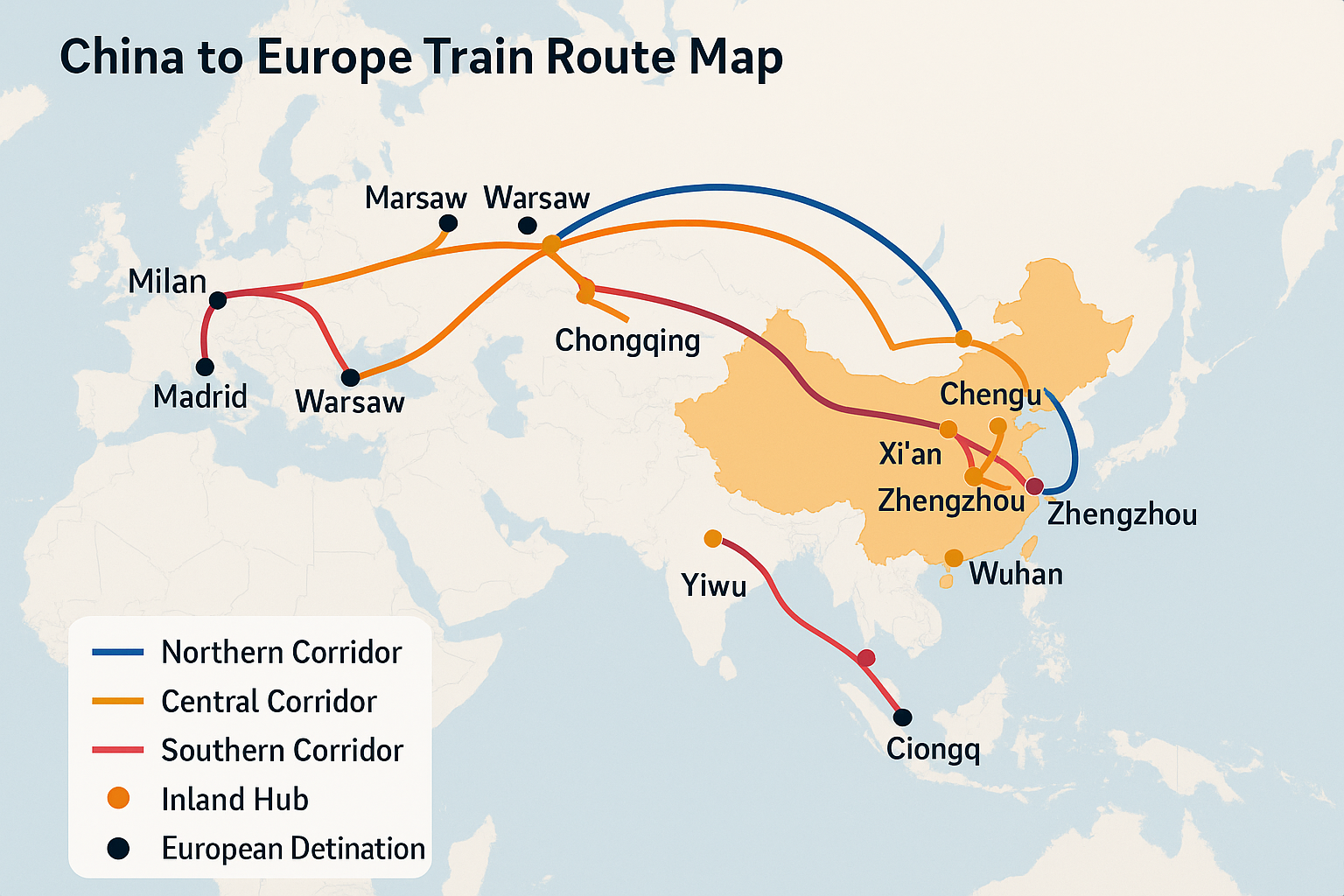
The map highlights three main rail corridors crossing Eurasia:
Northern Corridor – via Russia, serving Moscow and northern Europe.
Central Corridor – via Kazakhstan, Belarus, and Poland, leading to Germany.
Southern Corridor – via Turkey, extending to Spain and Italy.
Additionally, the map shows Chinese inland hubs such as Chongqing, Chengdu, Xi’an, Zhengzhou, Wuhan, and Yiwu, which serve as starting points.
Northern, Central, and Southern Routes Explained
Northern Corridor (via Russia)
This line passes through Mongolia and Russia, reaching European Russia and Germany. It is widely used for heavy industrial goods.
Central Corridor (via Kazakhstan–Belarus–Poland)
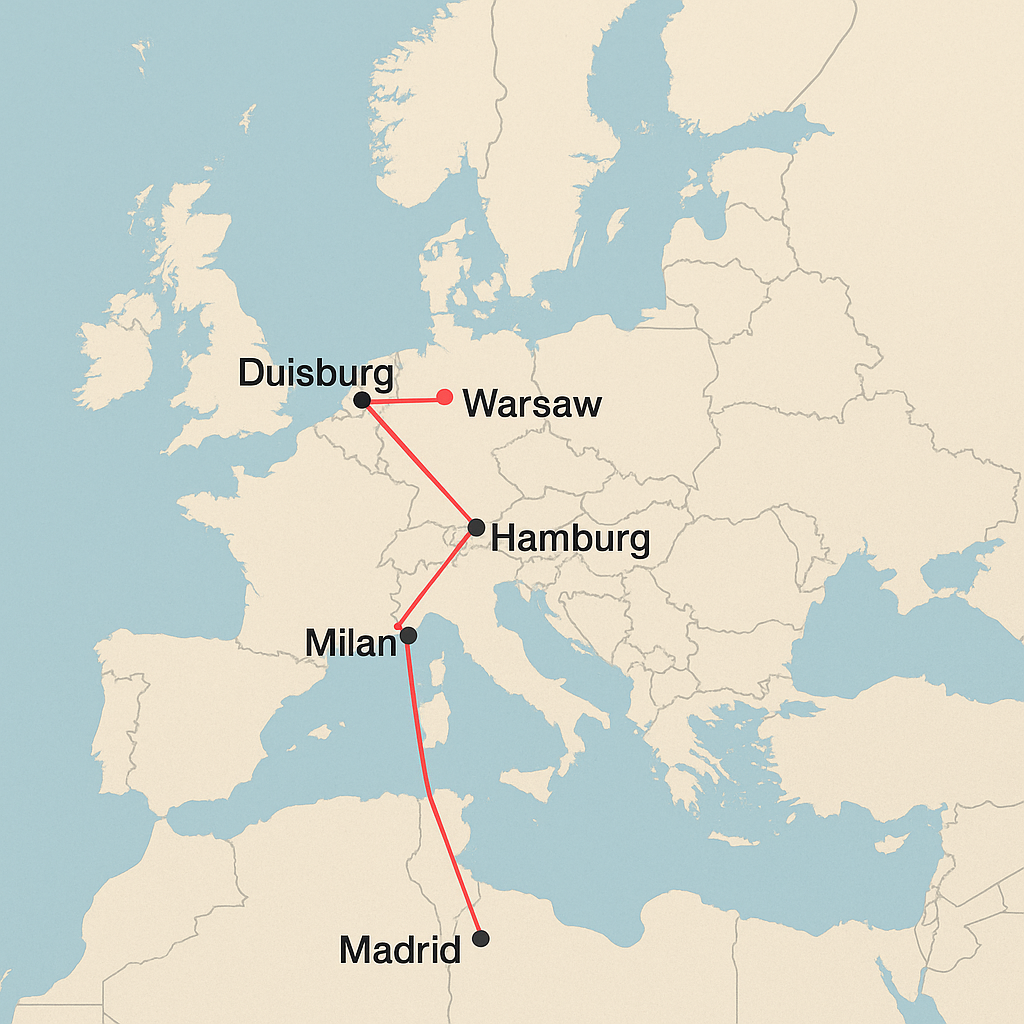
The most popular route, connecting Xi’an or Zhengzhou to Duisburg and Hamburg. Moreover, it avoids maritime congestion.
Southern Corridor (via Turkey)
The emerging path links China through Kazakhstan and Turkey to southern Europe, including Milan and Madrid. Although less frequent, it provides diversification.
The rail route map shows multiple borders requiring customs clearance:
China exit customs (Chongqing, Xi’an, etc.)
Kazakhstan entry at Alashankou or Khorgos
Poland entry at Malaszewicze (key EU gateway)
Moreover, gauge change is required from broad-gauge to standard-gauge rails, which may add one or two days to transit.
Pros and Cons of Rail Freight in the Route Map Context
Pros
Cons
Faster than sea freight
Costlier than sea freight
Cheaper than air freight
Border delays possible
Direct inland connections
Limited frequency vs. sea
Lower CO₂ emissions
Sensitive to geopolitical issues
Therefore, rail is a strategic middle-ground solution.
How Much Does Rail Freight Cost Along the Map?
Cargo Type
Avg. Cost (USD)
Notes
20GP
4,000–5,500
Depends on route
40HQ
7,000–9,000
Most popular for exports
LCL per CBM
180–250
Consolidation services
Furthermore, surcharges may apply for fuel or special handling.
Conclusion
In summary, the China to Europe train route map shows three strategic corridors linking inland China to European hubs. Rail freight reduces lead times to 15–20 days, supports sustainable logistics, and provides balance between cost and delivery speed.
Real cases from Chengdu, Wuhan, and Yiwu illustrate practical applications. Consequently, businesses seeking reliable supply chains should consider rail as a serious alternative to sea or air freight.
Consult TJ China Freight Forwarding for the lowest quote. They will provide you with reliable, cost-effective service.